Decision Literacy
How to think clearly, evaluate choices, and understand consequences.
Free and open educational curriculum
A free, open curriculum that teaches ages 8–12 how planetary systems work and where human infrastructure fits into them.
18 weeks of hands-on, experiment-driven lessons — each designed for about 20-30 minutes per session — designed for classrooms, homeschool families, after-school clubs, and any adult who wants to help kids move from vague environmental feelings to rigorous, physical systems-thinking about the planet they live on.
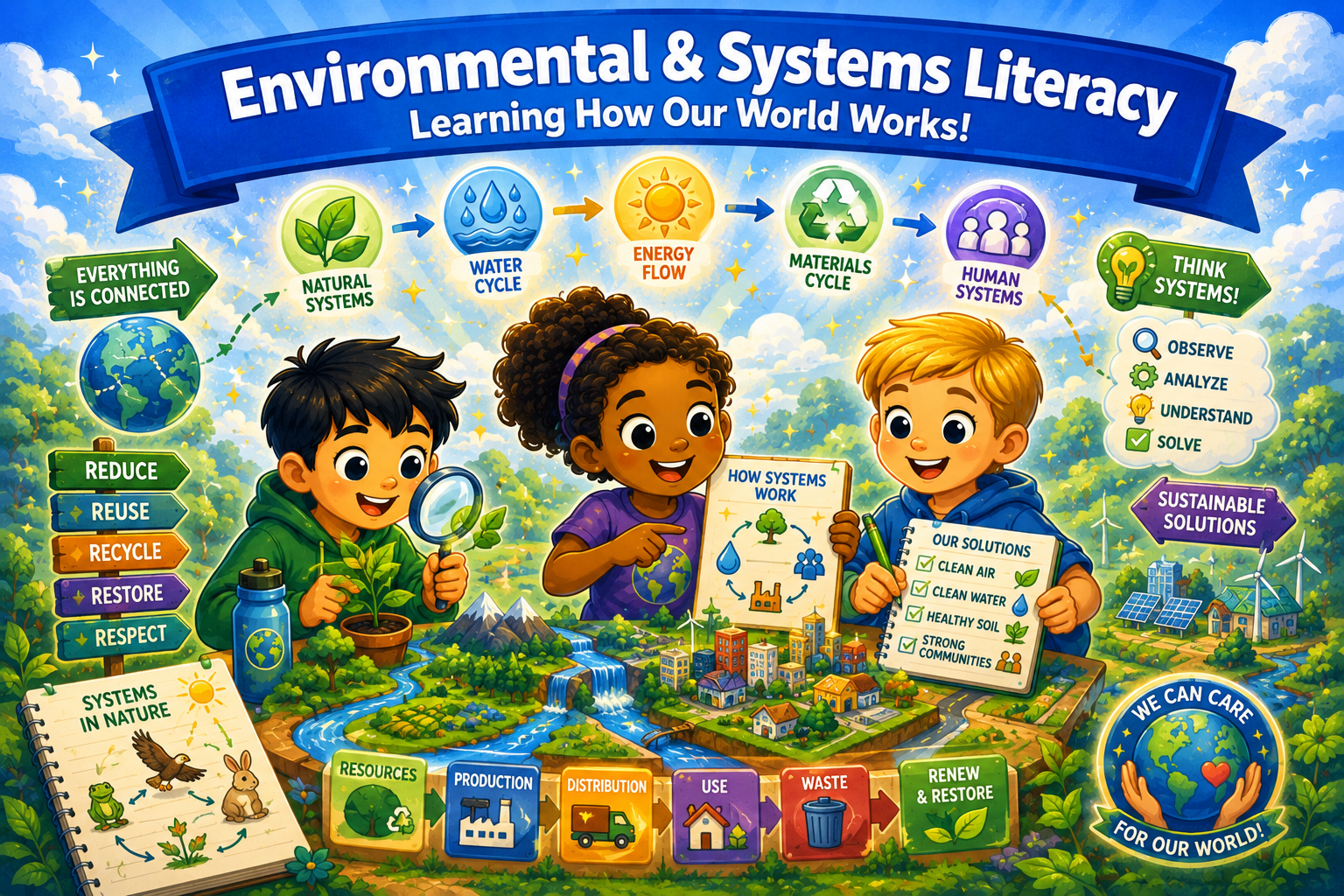
Environmental Systems Literacy is an 18-week curriculum for ages 8–12, built for classroom teachers, homeschool families, caregivers, and after-school leaders. Students take an engineering approach to the planet — learning how natural systems handle energy and matter, how human industrial systems interface with them, and how to identify and fix the failure modes when those two systems clash.
This curriculum is part of Literacy for Kids, a collection of open-source curricula designed to help children ages 8–12 understand the systems that shape the modern world.
How to think clearly, evaluate choices, and understand consequences.
How computers work and how to use technology responsibly.
How to find, interpret, and evaluate information.
How money and financial systems affect everyday life.
How societies organize themselves and how citizens shape communities.
How emotions, cognition, and social systems shape behavior and relationships.
How laws are built, how contracts work, and how disputes get resolved.
How planetary systems work and how human activity interfaces with them.
How the human body operates as an integrated system of feedback loops.
The curriculum is organized around mental models that help students transition from abstract environmentalism to rigorous, physical systems-thinking.
Earth is a closed system for matter. Students learn to trace the complete lifecycle of materials — waste is a system output that must become an input elsewhere.
Energy from the sun flows through the system and bleeds off as heat, but physical matter must be continuously recycled through the plumbing of the planet.
Nature usually reuses its materials in loops. Many human-made systems run in straight lines: take, make, use, throw away. Students learn to spot the difference — and where a return path is missing.
Every system has a limit to how much it can support. Students learn to see resource trouble as demand growing faster than the system can keep up.
Students explore balancing loops that stabilize systems and amplifying loops that lead to runaway states — applying systems thinking to the planet itself.
The learning progression moves from planetary thermodynamics through biogeochemical cycles, system limits, and circular economics, culminating in a real-world redesign proposal presented to a community audience.
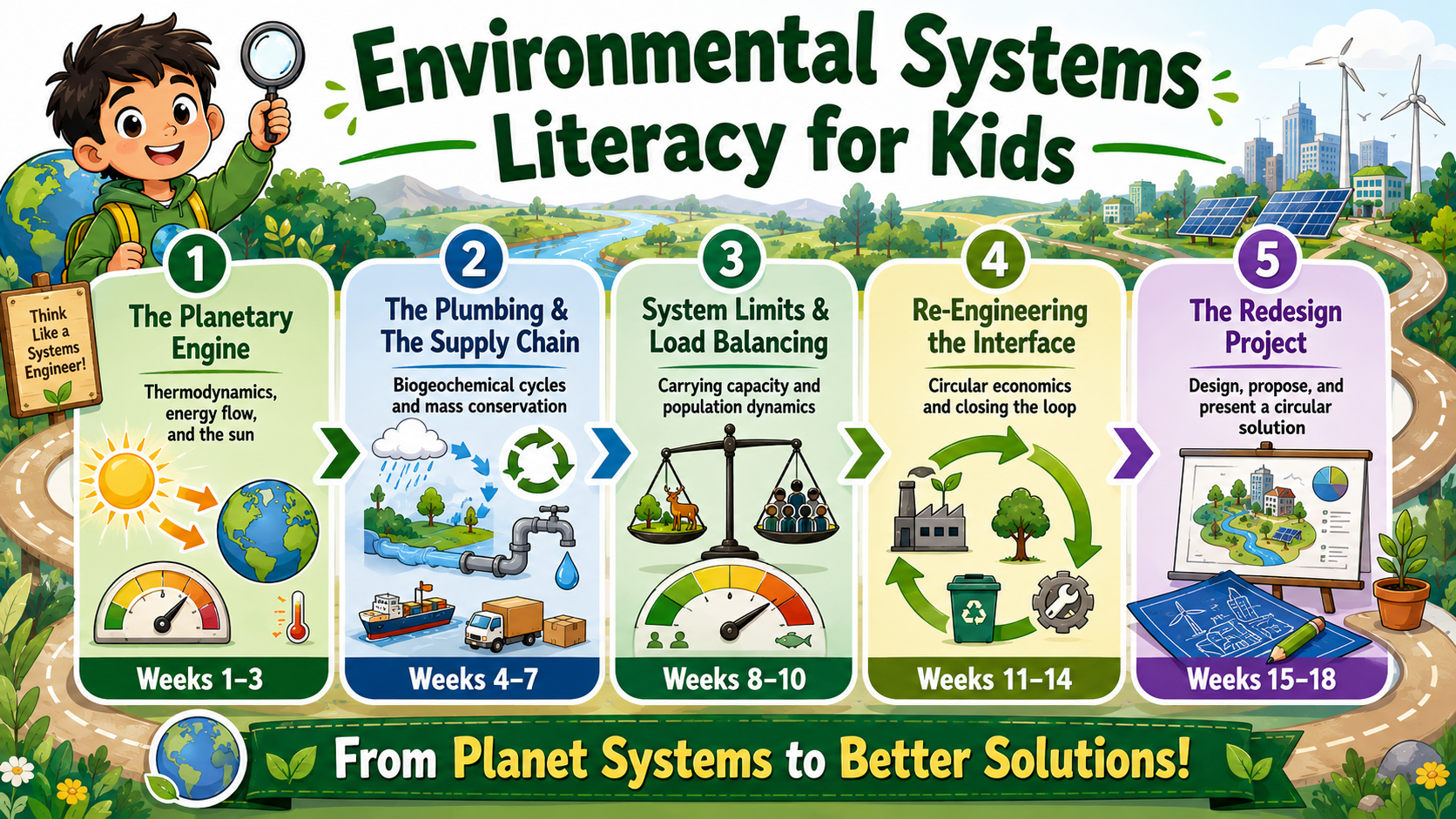
Weeks 1–3
Thermodynamics, energy flow, and the sun
Weeks 4–7
Biogeochemical cycles and mass conservation
Weeks 8–10
Carrying capacity and population dynamics
Weeks 11–14
Circular economics and closing the loop
Weeks 15–18
Design, propose, and present a circular solution
Begin with the Welcome page for an overview, then jump into Week 1. Each session is about 20 minutes — designed for ages 8–12.
Found a mistake or have a suggestion? Open an issue on GitHub.