Week 3: Build a Tiny World in a Jar (A Closed-Loop Micro-Ecosystem)
Unit 1: The Planetary Engine
This Week's Big Question
Can a tiny world keep going when most of its stuff stays inside?
This week feels magical on purpose. Children build a small world in a jar, watch water move around inside it, and begin to see what it means for matter to stay in a loop while sunlight still comes in.
Kid Version in One Sentence
In a terrarium, most of the stuff stays inside, but sunlight can still come in and keep the tiny world going.
You'll Discover
- how to build a simple terrarium layer by layer
- what each layer does in kid-friendly terms
- how water can travel inside a jar without leaving it
- Lead with wonder, not architecture vocabulary. "Tiny world" should come before "closed system."
- Keep the main sentence simple: stuff stays in, sunlight comes in.
- Sessions are designed for about 20 minutes. Use the Short Path when you only have 15-20 minutes. Extra Challenge options can stretch closer to 25-30 minutes.
Common Kid Misconceptions
- Misconception: "A sealed jar means nothing moves." Response: "Things can still move inside. Water, air, and plant growth keep changing places."
- Misconception: "The jar makes its own energy." Response: "No. Light still comes from outside."
- Misconception: "We should put bugs, worms, or wild animals inside and seal them up." Response: "Plants and soil are enough for this lesson. Do not seal wild animals in the jar."
Week at a Glance
| Session length | About 20 minutes |
| Prep time | About 15 minutes |
| Materials | Clear jar with lid, small rocks, charcoal if available, soil, small plants or moss, spray bottle, spoon, paper, Systems Log |
| Safety | Use clean materials; wash hands after handling soil; do not seal wild animals in the jar |
| Core vocabulary | terrarium, loop, soil, condensation, indirect light |
| Older learner words | closed for matter, open for energy, decomposition, oxygen, carbon dioxide |
Core Vocabulary
| Word | Kid-friendly meaning |
|---|---|
| terrarium | A tiny plant world in a clear container |
| loop | A path that comes back around instead of stopping |
| soil | Plant home where roots grow |
| condensation | Water drops forming on a cool surface |
| indirect light | Bright light nearby, but not harsh direct sun |
Short Path for Younger Learners
- Build the jar using the simple checklist.
- Make a Day 1 observation card.
- Draw where the water is on the first day.
- Revisit next time and compare what changed.
Success looks like: the child can explain that the terrarium keeps reusing water inside the jar.
Extra Challenge for Older Learners
- Explain why the terrarium is mostly closed for matter but open for energy.
- Track how often you see condensation and when it disappears.
- Compare two jars with different light levels or moisture levels.
Read-Aloud Opening
"Today we are building a tiny world in a jar. We are going to stack a few simple layers, add plants, and then watch what happens. The exciting part is that most of the water and matter stay inside and keep moving around instead of leaving."
Picture Checklist
Rocks -> charcoal -> soil -> plants -> mist -> lid -> indirect light

And here is a real, working bottle garden — look closely at the leaves and you can see water droplets. That is the tiny water cycle already running!
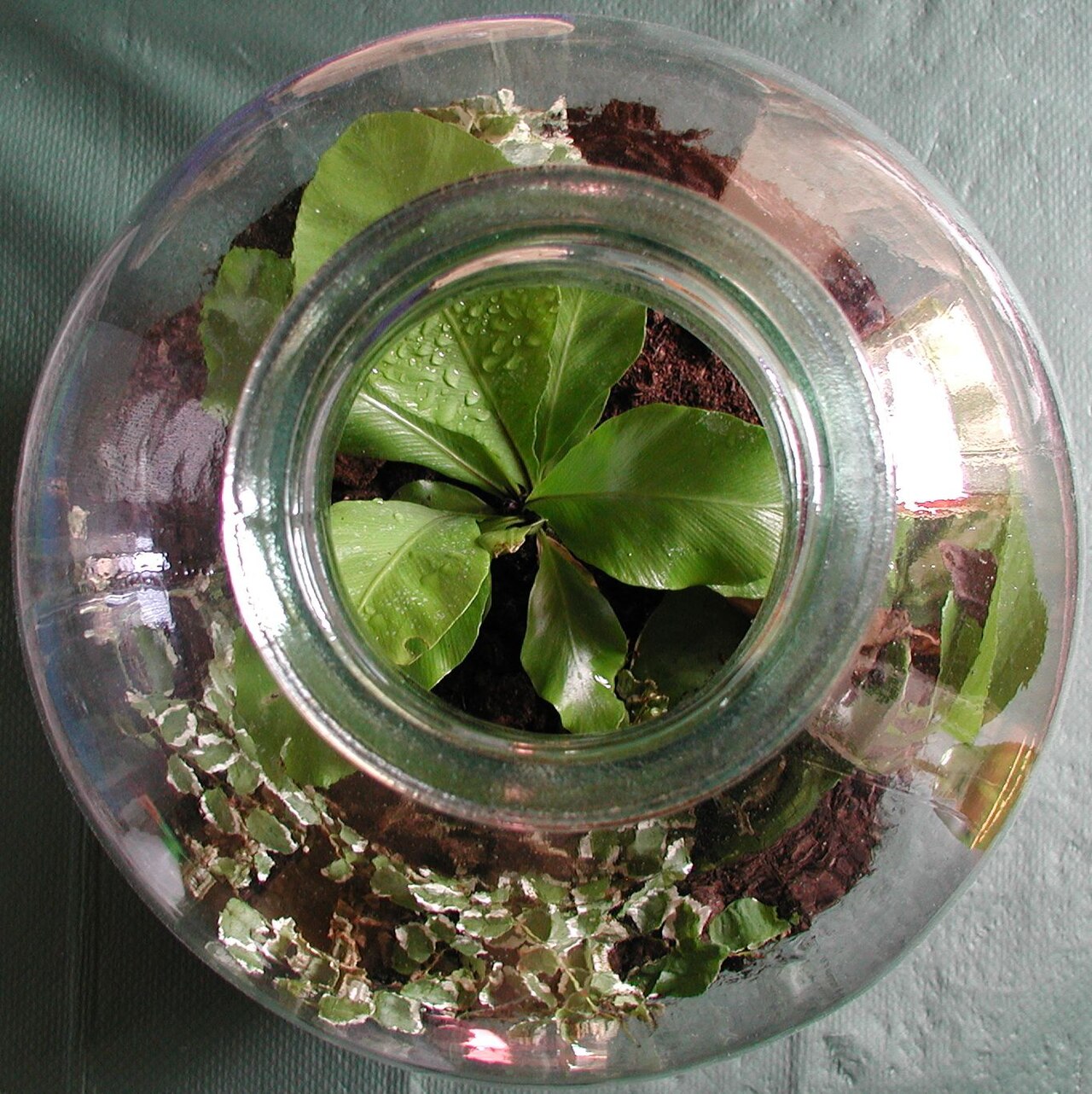
Photo: Anne-Lise Heinrichs, CC BY 2.0, via Wikimedia Commons
What Each Layer Does
- Rocks: a tiny basement where extra water can collect
- Charcoal: helps keep the jar fresher
- Soil: the plant home
- Plants: tiny sugar factories using sunlight
- Mist: gives the tiny world a starting drink
- Lid: helps keep the water inside
- Indirect light: gives energy without cooking the plants
Guided Session 1: Build the Jar
Building an experiment together works better with visible roles. One person can layer materials, one can record the setup, one can ask questions, and one can check the plan. Shared roles keep the jar from becoming one person's project. (More on the Collaboration Skills page.)
Time: 20-25 minutes
Materials: jar, rocks, charcoal if available, soil, plants or moss, spoon, spray bottle
Safety note: Use small plants only. Do not use poisonous plants or unknown wild animals.
Setup: Lay out all materials in the build order.
Activity steps:
- Add a thin rock layer.
- Add a small charcoal layer if you have it.
- Add soil.
- Plant the greenery.
- Mist lightly.
- Close the lid.
- Put the jar in indirect light.
What to ask:
- Which layer do you think matters most to the plants?
- Where do you think the water will be tomorrow?
- What do you think will happen on the glass?
Draw It: Draw the terrarium layers like a side-view picture and label them.
Talk About It:
- Why is the lid helpful in this system?
- What still has to come from outside the jar?
- What would happen if we forgot the light?
What success looks like: The child can explain what at least three layers are for.
Guided Session 2: Day 1 Observation and Prediction
Time: 20-25 minutes
Materials: terrarium, Systems Log, paper, pencil
Setup: Put the terrarium where the child can look closely at it.
Activity steps:
- Ask the child to look slowly at the jar from top to bottom.
- Make a Day 1 observation card.
- Ask where the water is now.
- Predict what might happen in a few days.
Use this first observation card:
- What do you see on Day 1?
- Where is the water?
- What do you predict will happen by next week?
Draw It: Draw the jar today and circle where water is hiding.
Talk About It:
- Do you think the water will stay in one place?
- What might happen on the inside of the lid?
- What changes would tell us the tiny world is working?
What success looks like: The child makes a prediction about water movement inside the jar.
Troubleshooting in Kid Language
- Too wet: swampy
- Too dry: crispy
- Too sunny: cooked plants
If the terrarium looks unhealthy, change one thing at a time and observe again.
Systems Log
Use this simple entry:
What I noticed:
What moved:
Where it came from:
Where it went:
My drawing:
One question I still have:
Helpful prompts for this week:
- What I noticed: "I saw water on..."
- What moved: "The water moved from... to ..."
- Where it came from: "The light came from..."
- My drawing: jar layers and water drops
Outdoor And Fieldwork Safety
- stay with a trusted adult or group
- wash hands after touching soil, plants, or shared tools
- use only known, safe plants and clean materials
- do not collect living things without permission
- use photos, drawings, or teacher-provided materials if outdoor collecting is not safe
When we study the environment, we observe carefully, stay safe, and respect living things.
Systems Thinking Move
This tiny world is still a system with connected parts. Water, air, soil, plants, and sunlight all matter.
- What parts are in this system?
- What moves through the system?
- What changes over time?
- What might happen later if one part changes?
Engineer Corner
Older learners and facilitators can connect the jar to formal systems language.
- The terrarium is mostly closed for matter: water and plant material stay in the jar unless you open it.
- It is still open for energy because sunlight enters.
- Plants use light to build sugars. Microbes help break old material down so it can be reused.
- Keep the carbon and oxygen details here as optional background, not as the main kid-facing path.